


VICTRON ENERGY
12V/24V 25A Buck-Boost DC/DC Converter
12V/24V 25A Buck-Boost DC/DC Converter
SKU:ORI303025000
Couldn't load pickup availability
⚡ VICTRON 12V/24V 25A BUCK-BOOST DC/DC CONVERTER
Programmable DC-DC Service Battery Charger for 12V & 24V Vehicle Systems – Smart Alternator Compatible, Engine-Running Detection & Input Current Limiting
⚡ The Victron Buck-Boost DC/DC Converter is designed for charging a 12V or 24V service battery in vehicles equipped with modern smart alternators, including applications associated with regenerative braking and Euro 5 and Euro 6 engine-management systems.
Modern vehicle alternators do not necessarily maintain a constant charging voltage while the engine is running. Depending on vehicle operating conditions and onboard electronics, alternator voltage can rise or fall significantly, which can make reliable auxiliary-battery charging difficult without appropriate DC-DC control.
The Victron Buck-Boost addresses this by providing a controlled, programmable charging output to the auxiliary battery. It can be configured for 12V or 24V auxiliary-battery systems supplied from either a 12V or 24V alternator and starter-battery system.
A built-in engine-running detection system helps prevent unnecessary discharge of the vehicle's starting battery, while programmable activation can alternatively be achieved using a suitable D+, CAN bus or (+)15 connection according to the supplied information.
The converter can also be programmed through a PC application, allowing important parameters such as charge current, input-current limitation and system configuration to be tailored to the installation.
⚡ KEY FEATURES
🔋 Designed for Service Battery Charging
Purpose-built for charging compatible 12V or 24V auxiliary/service batteries from a vehicle's alternator and starter-battery electrical system.
🚗 Smart Alternator Compatible
Designed for vehicles with intelligent or smart alternators, including systems associated with regenerative braking and Euro 5 and Euro 6 engines.
⬆️⬇️ Buck-Boost Conversion
Designed to control the charging output even when alternator voltage varies above or below the voltage required by the service-battery system.
⚡ 12V & 24V System Flexibility
Can be programmed to charge a 12V or 24V auxiliary battery from either a 12V or 24V alternator and starter-battery system.
🚦 Built-In Engine-Running Detection
Automatically detects appropriate engine-running conditions to help prevent deep discharge of the vehicle's starting battery.
🎛️ Programmable Activation Input
Can alternatively be activated through a programmable input using D+, CAN bus or (+)15 connection according to the supplied product information.
💻 PC Programmable
Can be fully programmed using a dedicated PC application.
🔌 USB Programming Connection
Programming requires a USB Type-A male to USB Type-B male cable according to the supplied information.
🔋 Adjustable Charge-Current Control
Output current is influenced by the configured maximum charge-current setting.
⚡ Input Current Limiting
Maximum input current can also be configured, helping the converter work within the limitations of the source electrical system.
🌡️ Temperature-Based Output Limiting
Maximum operating temperature is one of the factors that determines the available output current.
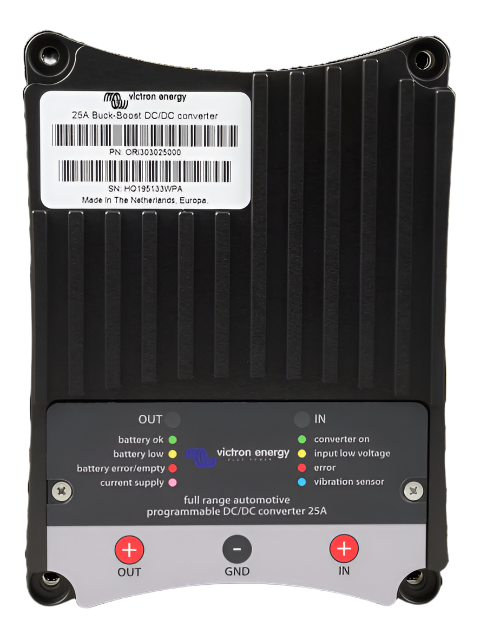
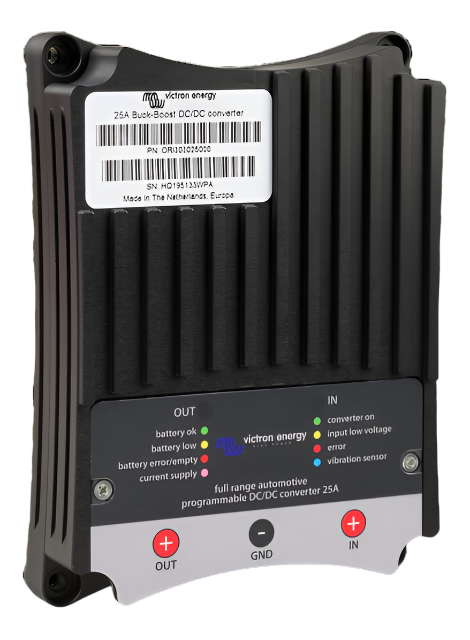
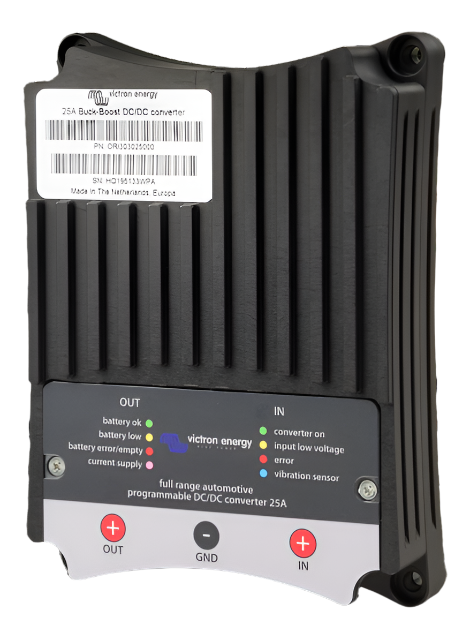
💡 Input Status LED
Multi-colour input-status indication provides information about converter operation, input voltage, engine-running detection and over-temperature conditions.
💡 Output Status LED
Provides clear indication of output operation and service-battery voltage condition.
🚗 DESIGNED FOR MODERN SMART ALTERNATORS
Modern smart alternators can behave very differently from traditional fixed-voltage charging systems.
In vehicles using intelligent alternator control, the alternator voltage may be actively varied by the vehicle's electronics depending on battery condition, acceleration, braking, fuel-efficiency strategy and other operating conditions.
The supplied product information specifically identifies applications involving:
- 🚙 Vehicles with smart or intelligent alternators
- ♻️ Regenerative-braking systems
- ⚙️ Euro 5 engine applications
- ⚙️ Euro 6 engine applications
The Buck-Boost converter provides a controlled charging output to the service battery rather than relying directly on fluctuating alternator voltage.
🔋 CONTROLLED AUXILIARY BATTERY CHARGING
The converter is designed to charge a compatible service battery using a pre-set charging voltage.
This helps prevent the auxiliary battery from simply being exposed to the varying voltage produced by the vehicle electrical system.
The supplied product information gives the example of high vehicle-system voltages such as 15.4V on some Mercedes applications, while smart alternators can also reduce voltage significantly under other operating conditions.
The Buck-Boost is designed to regulate these changing conditions into a controlled charging supply for the service battery.
⚠️ IMPORTANT: The supplied information does not provide specific charge-voltage settings for individual battery chemistries. Configure the converter according to the requirements of the battery manufacturer and the applicable Victron instructions.
⬆️⬇️ BUCK-BOOST OPERATION
A Buck-Boost converter is designed to manage situations where the available input voltage may be either higher or lower than the required output voltage.
This is particularly valuable in modern vehicle charging systems where alternator voltage can fluctuate substantially during normal driving.
Rather than depending on the vehicle system to remain at a suitable charging voltage, the converter regulates the supply delivered to the auxiliary battery according to its programmed configuration.
⚡ ONE CONVERTER FOR MULTIPLE SYSTEM CONFIGURATIONS
The supplied product information states that the Buck-Boost can be programmed to charge either a 12V or 24V auxiliary battery from either a 12V or 24V alternator and starter-battery system.
Supported system arrangements therefore include compatible configurations such as:
- 12V source system → 12V auxiliary-battery system
- 12V source system → 24V auxiliary-battery system
- 24V source system → 12V auxiliary-battery system
- 24V source system → 24V auxiliary-battery system
This flexibility allows one converter platform to accommodate a broad range of vehicle and auxiliary-power configurations.
⚠️ IMPORTANT: The converter must be programmed correctly for the actual vehicle and service-battery voltage before operation.
🚦 BUILT-IN ENGINE-RUNNING DETECTION
The Buck-Boost incorporates an engine-running detection system.
This function is designed to help prevent deep discharge of the vehicle's starting battery by ensuring the converter only operates when suitable engine-running conditions are detected.
This is especially important with modern smart-alternator systems because vehicle voltage alone may not behave like a traditional fixed-output alternator system.
🎛️ ALTERNATIVE PROGRAMMABLE ACTIVATION
Instead of relying solely on the built-in engine-running detection system, the converter can also be activated using a programmable input.
The supplied product information lists:
- D+ signal
- CAN bus*
- (+)15 connection
This allows the converter's operation to be integrated into compatible vehicle-control arrangements where required.
⚠️ IMPORTANT: The supplied source references CAN bus with an asterisk but does not include the associated footnote or detailed CAN-bus requirements. Do not assume direct compatibility with a particular vehicle CAN network without checking the applicable Victron documentation.
💻 FULLY PROGRAMMABLE BY PC
The converter can be fully programmed using a dedicated PC application according to the supplied product information.
This allows the installation to be configured for the required electrical system rather than relying on one fixed factory operating arrangement.
A USB Type-A male to USB Type-B male cable is required for programming.
⚠️ IMPORTANT: The supplied information states that this USB cable is required but does not state that the cable is included with the converter.
⚡ CHARGE CURRENT & INPUT CURRENT LIMITING
The converter's output current is determined by several operating parameters.
The supplied information identifies three main factors:
- ⚡ Maximum charge-current setting
- 🔌 Maximum input-current setting
- 🌡️ Maximum operating-temperature limit of the converter
This allows both the source side and battery-charging side of the installation to be considered when configuring the system.
🔌 INPUT CURRENT LIMITER
The programmable maximum input-current setting can be used to limit the demand placed on the source electrical system.
This is particularly relevant where alternator capacity, vehicle wiring or another source-side limitation needs to be considered.
⚠️ IMPORTANT: The correct current setting depends on the complete vehicle electrical system. Alternator capability, existing vehicle loads, cable size, voltage drop and protection all need to be considered.
🔋 CHARGE-CURRENT CONTROL
The maximum charge-current setting determines one of the limits placed on the converter's output.
The product title identifies this model as the 25A Buck-Boost DC/DC Converter.
Actual delivered charging current can still be affected by the configured input-current limit and the converter's operating-temperature limit.
⚠️ IMPORTANT: The supplied product information provided here does not include a complete detailed electrical specification table. Confirm the current Victron technical documentation where exact maximum, continuous or temperature-dependent current capability is required for system design.
🌡️ TEMPERATURE-DEPENDENT OUTPUT
The converter's maximum operating-temperature limit is one of the factors that determines available output current.
This means the actual charging current can be reduced when operating conditions require the converter to protect itself thermally.
Correct installation location and suitable ventilation are therefore important for maintaining dependable charging performance.
💡 INPUT STATUS LED INDICATION
The Buck-Boost provides colour-coded input-side status indication to help identify operating conditions.
🟢 Green – Converter On
Indicates that the converter is operating.
🟡 Yellow – Input Voltage Below Threshold
The converter is off because input voltage is below the configured or applicable threshold.
🔴 Red – Over Temperature
The converter is off because an over-temperature condition has been detected.
🔵 Blue – Quick Flash
Engine-running condition has been detected and the converter will start after the preset delay.
🔵 Blue – Slow Flash
The converter is off and activation is blocked due to low input voltage.
💡 OUTPUT STATUS LED INDICATION
The output-side LED provides information about converter state and service-battery voltage condition.
🟢 Green – Converter Off / Battery Voltage Normal
The converter is off and the connected battery voltage is considered normal according to the unit's configured operation.
🟡 Yellow – Converter Off / Battery Voltage Low
Indicates a low service-battery voltage condition while the converter is off.
🔴 Red – Battery Discharged or Not Connected
The converter is off and the battery is either discharged or not connected according to the supplied status description.
🟣 Purple – Converter On
Indicates that the converter is operating on the output side.
🚙 VEHICLE AUXILIARY-BATTERY SYSTEMS
The Victron Buck-Boost is designed specifically for vehicle-based auxiliary-battery charging and is particularly relevant where the vehicle's alternator output cannot be relied upon to remain at a traditional fixed charging voltage.
Potential compatible applications include:
- 🚙 4WD auxiliary-battery systems
- 🚐 Campervan electrical systems
- 🚚 Commercial vehicle auxiliary systems
- 🚑 Specialist and service vehicles
- 🏗️ Machinery and mobile equipment
- 🔋 12V auxiliary-battery installations
- 🔋 24V auxiliary-battery installations
- ⚡ Smart-alternator vehicle charging systems
♻️ EURO 5 & EURO 6 VEHICLE APPLICATIONS
The supplied product information specifically identifies vehicles with regenerative braking and Euro 5 or Euro 6 engines as applications for this converter.
These vehicles can use intelligent alternator control strategies that vary system voltage rather than maintaining a traditional constant charging voltage.
The Buck-Boost converter is designed to provide controlled service-battery charging despite those changing source conditions.
⚠️ IMPORTANT: Euro 5 or Euro 6 classification alone does not guarantee the exact charging configuration of a particular vehicle. Confirm the vehicle's charging system before installation.
🔋 HELPS PROTECT THE STARTING BATTERY
The built-in engine-running detection system is designed to prevent unnecessary deep discharge of the vehicle's starter battery.
By controlling when charging is permitted to begin, the converter helps separate auxiliary-battery charging from periods when the vehicle's source battery should not be heavily loaded.
⚡ MANAGES HIGH & LOW VEHICLE VOLTAGE
The supplied product information states that the converter charges the auxiliary battery using a pre-set charge voltage, eliminating the effects of excessively high or low vehicle-system voltages on the charging supply.
The source specifically gives approximately 15.4V on some Mercedes applications as an example of a high vehicle-system voltage.
This controlled charging approach is one of the key reasons a DC-DC converter is useful in modern intelligent-alternator vehicles.
🔧 PROGRAMMABLE SYSTEM FLEXIBILITY
The Buck-Boost is not limited to one fixed 12V-to-12V operating arrangement.
Its programmable architecture allows compatible installations to be configured around different combinations of source and auxiliary-battery voltage.
This makes it particularly useful for specialised vehicle electrical systems where the source voltage and service-battery voltage are not necessarily the same.
📋 PRODUCT INFORMATION SUMMARY
Product: Victron Buck-Boost DC/DC Converter
Product designation: 12V to 24V 25A Buck-Boost DC/DC Converter
Application: Vehicle service / auxiliary-battery charging
Smart alternator support: Yes – according to supplied product information
Regenerative-braking vehicle applications: Yes
Euro 5 / Euro 6 applications: Yes
Source-system configuration: Programmable for compatible 12V or 24V alternator / starter-battery systems
Auxiliary-battery configuration: Programmable for compatible 12V or 24V service-battery systems
Engine-running detection: Built in
Alternative programmable activation: D+, CAN bus* or (+)15 according to supplied information
PC programmable: Yes
Programming cable required: USB Type-A male to USB Type-B male
Maximum charge-current setting: Programmable
Maximum input-current setting: Programmable
Temperature-related current limitation: Yes
Input-status LED: Yes
Output-status LED: Yes
⚠️ SPECIFICATION NOTE: A complete electrical specification table including exact input ranges, output-voltage limits, dimensions, weight, IP rating and detailed battery-chemistry settings was not included in the supplied information and has therefore not been added here.
⚠️ INSTALLATION & COMPATIBILITY CHECKLIST
Before installing the Victron Buck-Boost DC/DC Converter, confirm that the complete vehicle and service-battery system is suitable.
- Vehicle starter-system voltage confirmed
- Auxiliary/service-battery nominal voltage confirmed
- Vehicle smart-alternator behaviour identified
- Battery manufacturer's charging requirements confirmed
- Maximum charge-current setting configured correctly
- Maximum input-current setting configured correctly
- Vehicle alternator capacity considered
- Existing vehicle electrical loads considered
- Correct input and output cable sizing
- Appropriate external circuit protection
- Engine-running detection configured correctly
- Programmable activation input configured correctly where used
- Suitable PC programming connection available
- Adequate installation ventilation
- Correct polarity confirmed before connection
⚠️ IMPORTANT: Smart-alternator installations can vary substantially between vehicle manufacturers and models. Confirm the vehicle's electrical architecture and the applicable Victron installation requirements before wiring the converter.
⚠️ IMPORTANT: Do not select charging voltage or current solely from the nominal battery voltage. Follow the battery manufacturer's charging specifications.
⚠️ IMPORTANT: The supplied information does not nominate cable size or fuse ratings. These should be determined from the actual current, cable run, voltage drop and complete installation design.
❓ FREQUENTLY ASKED QUESTIONS
What is the Victron Buck-Boost DC/DC Converter designed for?
It is designed to charge a compatible 12V or 24V service battery from a vehicle's alternator and starter-battery system, including vehicles equipped with intelligent or smart alternators.
Why is a DC-DC converter useful with a smart alternator?
Smart alternators can vary their output voltage considerably during normal vehicle operation. The Buck-Boost provides a controlled charging supply to the service battery rather than relying directly on changing alternator voltage.
Does it work with Euro 5 and Euro 6 vehicles?
The supplied product information specifically identifies regenerative-braking, Euro 5 and Euro 6 vehicle systems as intended applications.
Does every Euro 5 or Euro 6 vehicle require the same setup?
No. Charging-system behaviour can vary by manufacturer and vehicle configuration. The actual vehicle electrical system should be confirmed before installation.
What does Buck-Boost mean?
It refers to the converter's ability to regulate charging when the source voltage may be either above or below the required output voltage.
Can it charge a 12V auxiliary battery?
Yes. The supplied information states that the converter can be programmed to charge a compatible 12V service battery.
Can it charge a 24V auxiliary battery?
Yes. The supplied information states that it can also be programmed to charge a compatible 24V service battery.
Can it operate from a 12V vehicle electrical system?
Yes. The supplied information states that the converter can be programmed for use with a 12V alternator and starter-battery system.
Can it operate from a 24V vehicle electrical system?
Yes. The supplied information states that it can also be programmed for a 24V alternator and starter-battery system.
Can it convert 12V to 24V for auxiliary-battery charging?
Yes. The supplied product information states that a 24V auxiliary battery can be charged from a compatible 12V alternator and starter-battery system when the converter is correctly programmed.
Can it convert 24V to 12V for auxiliary-battery charging?
Yes. The supplied information states that a 12V auxiliary battery can also be charged from a compatible 24V source system when correctly configured.
How does it know when the engine is running?
The converter incorporates a built-in engine-running detection system.
Why is engine-running detection important?
It helps prevent the converter from unnecessarily discharging the vehicle's starter battery when charging conditions are not appropriate.
Can I use another signal instead of automatic engine-running detection?
Yes. The supplied information states that a programmable input may be used instead.
What activation inputs are mentioned?
The supplied information lists D+, CAN bus* and (+)15 connection as possible programmable activation methods.
Can I connect it directly to any vehicle CAN bus?
Do not assume this. The supplied source references CAN bus but does not include the associated footnote or detailed compatibility requirements. Check the applicable Victron documentation for the vehicle and installation.
Can the converter be programmed?
Yes. The supplied information states that it is fully programmable using a PC application.
What cable is required for programming?
A USB Type-A male to USB Type-B male cable is required according to the supplied information.
Is the USB programming cable included?
The supplied information states that the cable is required but does not state that it is included.
Can the charging current be adjusted?
The supplied information states that maximum charge current is one of the programmable factors determining converter output current.
Can input current be limited?
Yes. A maximum input-current setting is one of the supplied programmable parameters.
Why would I limit the input current?
Input-current limiting can help configure converter demand to suit the capacity of the source electrical system, subject to the complete vehicle installation requirements.
Does temperature affect charge current?
Yes. The supplied information states that the converter's maximum operating-temperature limit is one of the factors that determines available output current.
What does a green input LED mean?
Green indicates that the converter is on.
What does a yellow input LED mean?
Yellow indicates that the input voltage is below the required threshold and the converter is off.
What does a red input LED mean?
Red indicates an over-temperature condition and the converter is off.
What does a quickly flashing blue input LED mean?
It indicates that engine running has been detected and the converter will start after its preset delay.
What does a slowly flashing blue input LED mean?
It indicates that the converter is off and activation is blocked because the input voltage is too low.
What does a green output LED mean?
According to the supplied information, green indicates that the converter is off and service-battery voltage is normal.
What does a yellow output LED mean?
Yellow indicates that the converter is off and service-battery voltage is low.
What does a red output LED mean?
Red indicates that the converter is off and the battery is discharged or not connected.
What does a purple output LED mean?
Purple indicates that the converter is on.
Can I use this with an AGM battery?
The supplied information confirms programmable service-battery charging but does not provide battery-chemistry-specific charging parameters. Confirm the AGM battery manufacturer's required settings and the applicable Victron configuration guidance.
Can I use this with a lithium battery?
The supplied information does not specifically state lithium compatibility or provide lithium-specific charging settings. Confirm compatibility with the exact battery, BMS and current Victron documentation before installation.
Does it protect the vehicle's starter battery?
The built-in engine-running detection system is specifically intended to help avoid deep discharge of the vehicle's starting battery.
Is the product permanently set for 12V to 24V operation?
No. The supplied information states that the converter can be programmed for different combinations of 12V and 24V source and service-battery systems.
What is the maximum current?
The product designation identifies this version as the 25A model. The supplied information also states that actual output current is determined by the maximum charge-current setting, maximum input-current setting and maximum operating-temperature limit.
What cable size and fuse should I use?
The supplied information does not specify cable size or fuse ratings. These should be selected according to the actual configured current, cable length, voltage drop, source capacity and applicable installation requirements.
What should I check before ordering?
Confirm the vehicle's starter-system voltage, service-battery voltage, smart-alternator behaviour, required battery charge settings, available alternator capacity, desired current limits, control method and installation requirements before purchase.
⚡ PROGRAMMABLE SMART-ALTERNATOR CHARGING FOR MODERN VEHICLE ELECTRICAL SYSTEMS
The Victron 12V to 24V 25A Buck-Boost DC/DC Converter is designed for vehicle installations where reliable auxiliary-battery charging cannot depend on a traditional fixed alternator voltage.
With smart-alternator support, Buck-Boost voltage control, built-in engine-running detection, programmable D+ / CAN bus* / (+)15 activation options, PC configuration, charge-current control, input-current limiting and support for both 12V and 24V source and service-battery arrangements, it provides considerable flexibility for modern and specialised vehicle electrical systems.
Correct programming and installation are essential. Confirm the vehicle charging system, battery requirements, current limits, wiring, protection and activation method before installation to ensure the converter is correctly configured for the application.
Share
SS - Product Addons
Select product(s) to see addons appear.
This message only appears in theme editor.

